

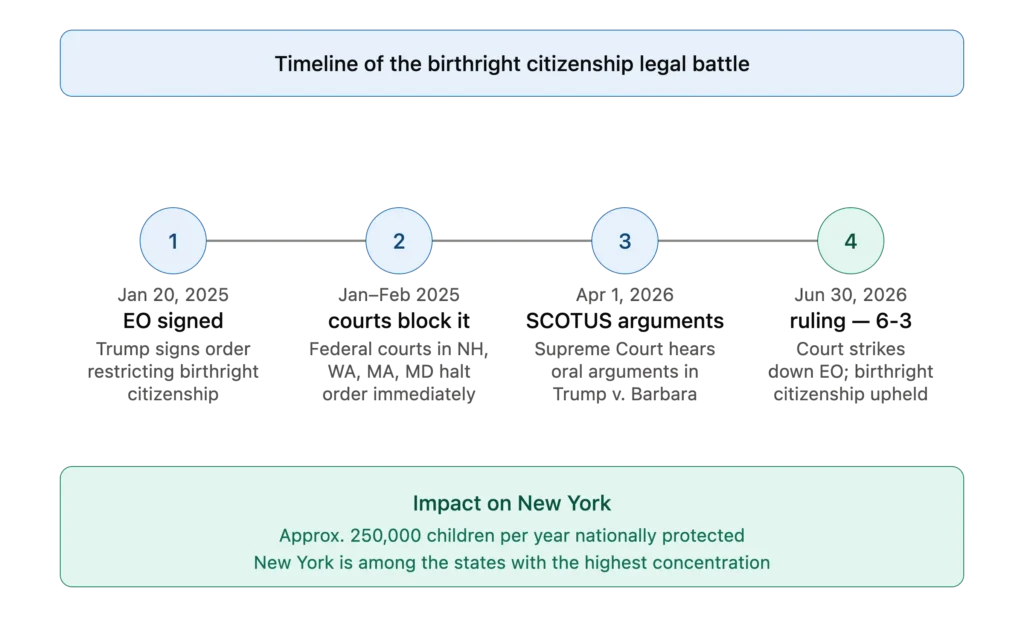
Birthright citizenship is protected. The Supreme Court made that clear this morning. In a 6-3 decision handed down June 30, 2026, the justices struck down President Trump’s executive order and reaffirmed what the 14th Amendment has meant for over 160 years. If your child was born in the United States, they are a citizen. That did not change today. Today, the highest court in the country confirmed it. For the families we serve across New York, many of whom spent the last 18 months worried about what this ruling would mean, I want you to read that again. Your child is a citizen. The law is on your side.
What the Court Decided This Morning
The Vote , 6 to 3
Chief Justice John Roberts wrote the majority opinion. He was joined by Justices Sotomayor, Kagan, Barrett, and Ketanji Brown Jackson on constitutional grounds. All five agreed: Trump’s executive order violates the 14th Amendment to the U.S. Constitution. The order is permanently struck down. It cannot take effect now or in the future without an entirely new legal and legislative battle.
What Roberts Actually Said
“Citizenship, then and now, was the right to have rights , to freely participate in our political community. The Framers of the Fourteenth Amendment extended that promise to every free-born person in this land. We keep that promise today.” Those are Roberts’ words. That is the law of this country.
Kavanaugh’s Concurrence , the Part That Matters Going Forward
Justice Kavanaugh agreed the order must fall, but he wrote separately. He chose to invalidate it on statutory grounds only , specifically, that it conflicts with the Immigration and Nationality Act, which Congress codified in 1952. By not reaching the constitutional question, Kavanaugh left a narrow theoretical door open for future congressional action. That matters for what comes next politically. For today, the result is the same: birthright citizenship stands.
The Dissent
Justices Thomas, Alito, and Gorsuch dissented. They argued the Citizenship Clause was never intended to apply broadly to children of non-citizen parents. That view has been rejected by American courts for over a century. It was rejected again today. Three justices, not five. The majority held.
Who This Ruling Protects , And It Is a Lot of Families in New York
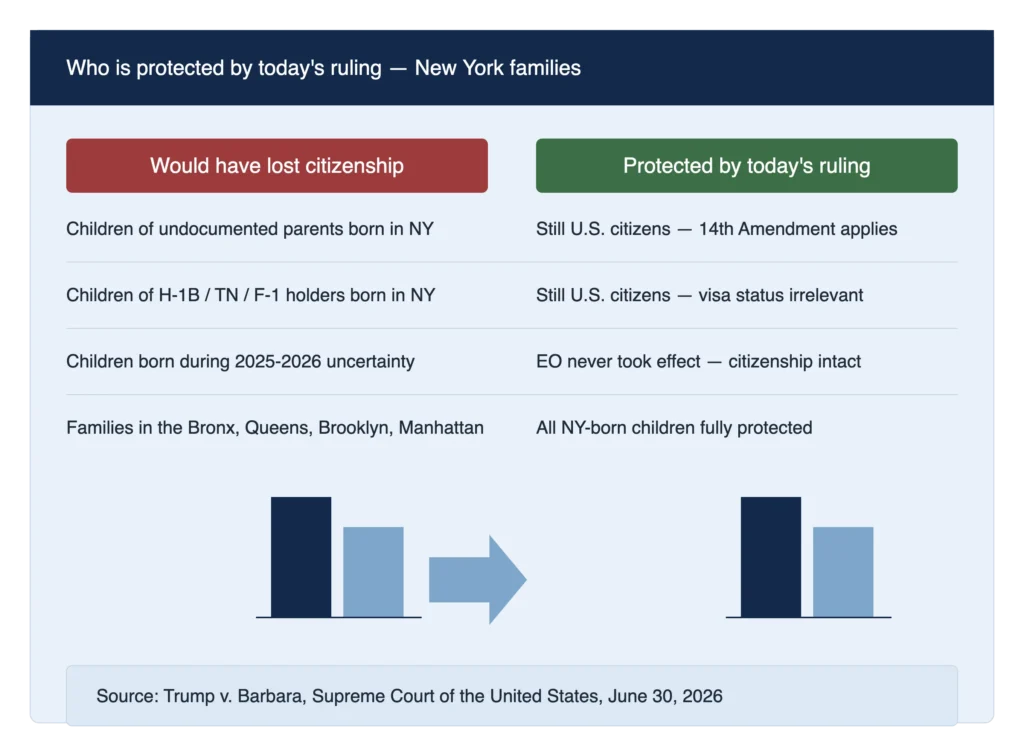
Children of Undocumented Parents
Trump’s order specifically targeted children born in the U.S. to parents who entered without legal authorization. These children , under the executive order , would have been rendered stateless. No U.S. citizenship. No automatic citizenship in their parents’ home countries in many cases. Born in New York, with nothing. The Court said no. Your child born here is a U.S. citizen, regardless of your status when they were born. Our family immigration attorneys in New York can walk you through how that connects to your own case.
Children of Temporary Visa Holders
The order also targeted families on temporary work and student visas , H-1B, TN, F-1, J-1, O-1. Many of our clients came here legally, built careers, paid taxes, and then found themselves wondering whether their U.S.-born child would be denied the citizenship that child was born into. The Court’s ruling covers these families too. A child born in the United States is a citizen. Their parents’ visa category is not relevant to that.
250,000 Births Per Year Were at Stake
According to the Migration Policy Institute and Penn State’s Population Research Institute, approximately 250,000 babies are born each year in the U.S. who would have been denied citizenship under the executive order. New York , with the Bronx, Queens, Brooklyn, and Manhattan among the most immigrant-dense communities in the country , has one of the highest concentrations of affected families. Every one of those children is protected today.
Practical rule: If your child was born in the United States, they are a U.S. citizen. That was true before today. Today the Supreme Court said it out loud, to the whole country.
The History the Court Built This Decision On
Wong Kim Ark | 1898
The Supreme Court answered this question 128 years ago. Wong Kim Ark was born in San Francisco to Chinese immigrant parents. Read the full decision on Justia. When he returned from a trip to China in 1895, he was denied re-entry. The government said he was not a citizen. The Supreme Court said he was , 6 to 2 , because he was born on U.S. soil. That decision has governed American law through every wave of immigration hostility this country has ever produced. Today’s majority cited it directly and reaffirmed it.
Congress Wrote It Into Law Twice
Beyond the Constitution, Congress codified birthright citizenship in the Nationality Act of 1940 and again in the Immigration and Nationality Act of 1952. This is the statute Kavanaugh relied on in his concurrence. There are two independent legal foundations here , the 14th Amendment and federal statute , and both support the same outcome.
Even During Internment
Roberts’ opinion made a point worth sitting with. During World War II, when Japanese Americans were held in internment camps as enemy aliens, their newborn children on U.S. soil were automatically granted citizenship. Even in the darkest period of anti-immigrant policy in modern American history, birthright citizenship was untouchable. That is the principle the Court upheld again today.
What Your Family Should Do Right Now
If Your Child Is Already Born in the U.S.
Nothing has changed for them. They were a citizen before this morning and they remain one now. The executive order never took effect , it was blocked by federal courts immediately after it was signed in January 2025. Today’s ruling simply eliminates any legal uncertainty permanently. If you have not yet obtained a U.S. passport for your child, that is worth doing now. Not because of any legal risk. Just to have the documentation in order.
If You Are Expecting a Child
Your child, born in the United States, will be a U.S. citizen. Full stop. The order is permanently struck down. There is no pending legislation that changes this. If you have questions about how your child’s citizenship interacts with your own immigration case, reach out to us. That is exactly the kind of conversation we have with families every day.
If You Have a Pending Immigration Case
Today’s ruling does not directly change a removal proceeding, a green card application, or a DACA renewal. But having a U.S.-citizen child is always a relevant fact in immigration proceedings. It does not automatically resolve everything. But it is never irrelevant either. If you are in removal proceedings and you have a U.S.-born child, that is a conversation worth having with an attorney before your next hearing.
Practical rule: A U.S.-citizen child changes what options are available in a removal case. It does not guarantee a result, but it opens doors that would otherwise be closed.
The Legal and Political Road Ahead
What Kavanaugh’s Concurrence Opens Up
By ruling only on statutory grounds, Kavanaugh signaled that a future Congress could theoretically attempt to amend the Immigration and Nationality Act to restrict birthright citizenship without relying on executive action. If that were attempted, it would be challenged immediately on 14th Amendment grounds. That challenge would return to the Supreme Court. Whether five justices would then revisit the constitutional question , given today’s strong majority , is genuinely uncertain. We are tracking this closely.
Three Dissenting Justices Is Not Nothing
Thomas, Alito, and Gorsuch remain committed to a narrower reading of the Citizenship Clause. Combined with Kavanaugh’s refusal to reach the constitutional question, there are four justices who either dissented or left the door open. That is one vote away from a different outcome in a different posture. This is not a reason for fear today. Today’s ruling is clear and decisive. But staying informed matters.
What This Means for New York Specifically
New York’s immigrant communities , across every borough , have lived with this uncertainty since January 2025. The Bronx, Queens, Brooklyn, and Manhattan are home to hundreds of thousands of families whose children were born here while their parents navigated the immigration system. Today the Supreme Court told every one of those families that their child’s citizenship was never going to be taken away. We are glad to deliver that news.
Practical rule: The Supreme Court upheld the principle that citizenship attaches to the child, not the parent. That distinction matters for every immigrant family with a U.S.-born child.
Your Questions, Answered
| Question | Answer |
|---|---|
| My child was born in New York while I was undocumented. Are they a citizen? | Yes. The Supreme Court confirmed this today. Your child’s birthright citizenship is protected by the 14th Amendment. |
| I’m here on a work visa. My child was born in New York. Are they a citizen? | Yes. Today’s ruling explicitly covers children born to parents on temporary visas. Your child is a U.S. citizen. |
| Did the executive order ever actually take effect? | No. It was blocked by federal courts immediately and never took legal effect. Today’s ruling permanently strikes it down. |
| Can Congress still change the birthright citizenship law? | Kavanaugh’s concurrence leaves that theoretical path open. But any congressional change would face a 14th Amendment challenge and return to the Supreme Court. |
| Does this help my deportation case? | Not directly, but having a U.S.-citizen child is often relevant in removal proceedings. Talk to an attorney about your specific situation. |
| What documents should my U.S.-born child have? | A U.S. birth certificate, and when applicable, a U.S. passport. An attorney can advise on documentation specific to your family’s situation. |
| Does this affect my DACA renewal? | Not directly. DACA renewals are a separate process. But today’s ruling reinforces the constitutional rights of U.S.-born children of immigrant parents. |
| I had a baby in 2025 during all the uncertainty. Is my child definitely a citizen? | Yes. The executive order never took effect, so your child’s citizenship was never in question legally. Today’s ruling removes any remaining doubt permanently. |
Practical rule: Today’s decision is one of the most consequential Supreme Court rulings on immigration rights in a generation. Your child’s citizenship is not a political question. It is a constitutional right the Court just reaffirmed.
A Note From Our Office
I have been serving New York’s immigrant families for years. I am an immigrant myself. I know what the past 18 months of uncertainty about birthright citizenship felt like for families who did nothing wrong except build their lives here. The fear was real. The questions were exhausting. Parents sat across from us and asked whether their newborn would be considered a full citizen of the only country that child had ever known.
Today the Supreme Court answered that question. And the answer is yes.
If you still have questions about your child’s documentation, your own immigration status, or how today’s ruling connects to any pending case, we are here. That is what our New York immigration team does. Reach out anytime.
Your Family Has Rights , NY Zavala Is Here to Protect Them
Zavala Immigration Law Firm has served immigrant families across New York in English and Spanish. If today’s ruling raised questions about your case, call us at (718) 717-7989 or visit our contact page to schedule a consultation. We handle family immigration, green cards, deportation defense, DACA renewals, and more.
About Eliud Zavala
Eliud Zavala is the founder of NY Zavala Immigration Law Firm, serving immigrant families throughout New York. He immigrated with his mother and has dedicated his legal career to the communities he grew up alongside. He handles marriage green cards, family petitions, DACA renewals, provisional waivers, removal defense, and naturalization in New York. He serves clients in English and Spanish.