

What Happens After Your Citizenship Interview in New York
A citizenship interview ends with a piece of paper, not a ceremony, and that paper sets your next few months. Most people in New York walk out holding Form N-652 with a box checked. Few of them know what that box means. Some are approved on the spot. Some are told a decision cannot yet be made. A few are denied and handed a deadline they never notice. This guide explains each result and the timeline that follows it. It also covers the moves that protect your case after the questions end.
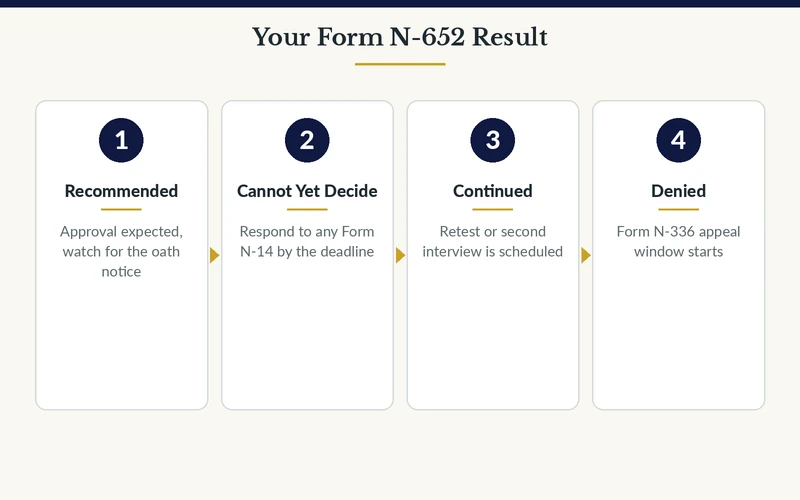
- Recommended for approval means the officer expects to grant the case after an internal quality review.
- A decision cannot yet be made is a pause, not a denial, and the reason is usually on the paper.
- Continued cases get one retest or one evidence request, and a missed date can end the case.
- Denied cases carry a short appeal window that starts the day you receive the notice.
What your citizenship interview result means tonight
You walked out of the office holding one sheet of paper. The officer may have said something quick about approval or about a decision. That sheet, Form N-652, is the record from your citizenship interview. You will rely on it for months.
Reading the boxes on your result paper
USCIS gives every applicant a notice of results at the end of the exam. The officer marks one outcome on Form N-652. Each box means something different, and one of them starts a clock. Read the paper before you leave the building, and photograph it.
If a box is unclear, ask the officer to explain it while you are still there. You are standing next to someone who has your file open. A question now costs nothing.
What recommended for approval does and does not promise
A recommended result means the officer found you eligible and expects to grant the case. It is not the grant itself. Every approved application goes through an internal quality review by a different officer. That reviewer can raise an eligibility issue before anything gets scheduled. So a recommendation is good news with one step left.
Approval also does not make you a citizen. It means USCIS intends to naturalize you. Nothing changes legally until you take the oath.
Why an officer says a decision cannot yet be made
Sometimes the interview goes well and the officer still cannot decide that day. A file may be missing a record. A supervisor may need to review something. The officer then marks that a decision cannot yet be made. This is a pause, not a denial, and it is common.
Your job after that box is to watch the mail and your online account. Keep your address current with USCIS while the case sits. A notice sent to an old address can cost you a deadline.
Continued is not the same as denied
A continued case means the officer wants more information before deciding. USCIS may continue the exam once so you can fix a problem. The officer must tell you in writing what to correct or what evidence to send. You get a real chance to answer, and most people use it well.
Still waiting for a date? Our guide on how long a New York citizenship interview takes explains the scheduling.
How USCIS reaches a decision after the citizenship interview
The agency works on a clock that most applicants never hear about. The citizenship interview starts that clock. Knowing it changes how you read every notice that follows.
The clock that starts at your interview
Federal regulation sets a deadline for the agency. USCIS must grant or deny your case at the interview or within 120 days after that first exam. The rule is written plainly in 8 CFR 335.3. If the agency misses that window, you have a court remedy. The statute at 8 U.S.C. 1447(b) lets you ask a district court to hear the case.
That remedy is real, and it has limits. The court can decide your case itself or send it back with instructions. Filing also moves your file into a courtroom, where the government appears and defends its position. Timing matters, so speak with a lawyer before you file.
Why an officer continues a case instead of deciding it
Continuance is the agency’s tool for a fixable problem. The rule allows one reexamination so you can overcome a deficiency. The officer must put the grounds in writing.
The reexamination is normally scheduled inside the 120 days window. An officer can also continue a case to request evidence, and USCIS generally allows about 30 days to respond. Missing that date lets the officer decide on the record you left behind.
What a denial notice must tell you
A denial arrives in writing. The notice must state the facts behind the decision. It must cite the requirement you did not meet. It must also explain how to request a hearing, as the USCIS policy manual on examination results describes.
Read the citation, not just the opening paragraph. Denials usually rest on one or two specific findings. Those findings tell you what a hearing has to overcome. They also tell you whether the case is worth appealing at all.
Practical rule: Calendar the date you received the denial, not the date printed on the letter. Your 30 days run from receipt, and mail can eat a week.
Your timeline after the citizenship interview
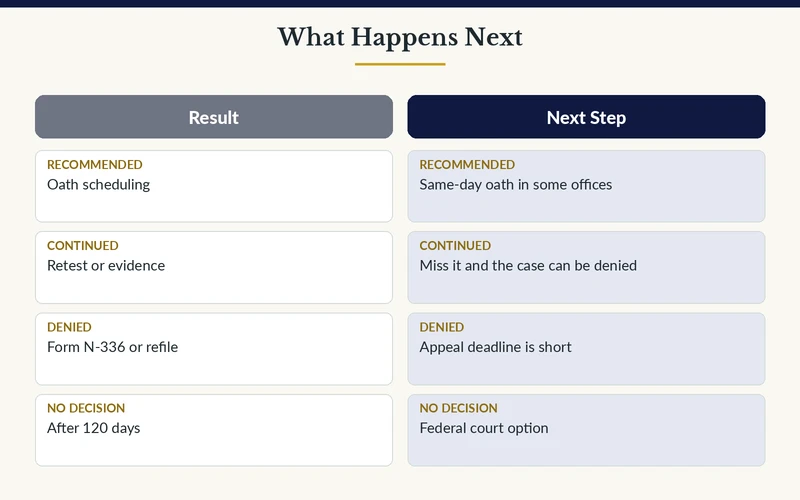
Four paths open from the citizenship interview, and each one has its own clock. Find your box in the table first, then read the section under it. Bring the paper to any lawyer you consult.
| Result on your N-652 | What it means | What happens next | Timeframe |
|---|---|---|---|
| Recommended for approval | Officer expects to grant after quality review | Oath ceremony gets scheduled | Weeks to a few months |
| Decision cannot yet be made | Case is still under review | Watch the mail and your online account | No fixed date |
| Continued for a retest | You failed part of the English test or civics test | Second test is scheduled | 60 to 90 days |
| Continued for evidence | Officer issued Form N-14 | Send documents by the date on the form | About 30 days |
| Denied | Officer found you ineligible | File Form N-336 to request a hearing | 30 days from receipt |
If you were recommended for approval
Nothing else is required from you at that point. USCIS finishes its quality review and then schedules the oath ceremony. Expect a notice in the mail with a date and a place. Do not book international travel before you read that notice.
Bring your green card to the ceremony. Report any change of address right away. If you move between approval and the ceremony, tell USCIS the same week.
If you must retake a test
A failed English test is not the end of the case. The regulation gives you a second chance within 90 days of the first exam. USCIS practice is to schedule that retest between 60 and 90 days out. You only retake the portion you failed, so study that part hard.
Skip the second appointment without good cause and USCIS treats it as a failure. Ask for a new date in writing before the appointment if you cannot attend. Moving the test past 90 days requires a written waiver of the 120 days deadline. That waiver restarts the clock at the second interview under 8 CFR 312.5.
USCIS has used different versions of the civics test over the years. Which version applies depends on when you filed your N-400. Check your appointment notice and the current test page on uscis.gov before you open a study guide.
If you received a document request
Form N-14 is the request an officer hands you when something is missing. It lists what USCIS wants and the date by which to send it. Treat that date as a hard deadline, because it is one.
Send clean copies, never originals, unless the form asks for originals. Add a short cover letter that matches each request to each document. Keep proof of mailing and a full copy of the packet.
If your case was denied
A denial starts a short appeal window. You have 30 days from the day you receive the notice, or 33 days if USCIS mailed it. The request goes on Form N-336. Filing it keeps the case alive and puts a second officer on the record.
You remain a lawful permanent resident after a denial. Losing the application is serious, but it does not take your green card. That distinction matters when you decide how hard to fight.
Practical rule: Before you refile, ask whether a Form N-336 hearing is the better route. The two options carry different costs and timing.
Documents that decide continued and denied cases
Most losses after a citizenship interview are paperwork losses. The officer asked for something specific, and the answer arrived late or incomplete. Fixing that is about organization and speed.
What to bring to a retest
Bring the appointment notice, your green card, and a state ID. Bring whatever study sheets you use, and arrive early enough to sit quietly. The retest itself is short, and nerves cause most of the trouble.
If you qualify for an age based exception, raise it before you test again. If a disability affects your ability to test, ask about a medical certification for an exception. Both requests work better early than late.
How to answer a request for evidence
Answer by paragraph number and send exactly what is listed. If a document does not exist, say so in writing and explain why. Silence reads as a refusal to cooperate.
If a record is slow to arrive, send proof that you ordered it. A receipt from a court or an agency shows good faith. Ask for more time in writing before the deadline passes.
Records worth ordering now
Order court dispositions, tax transcripts, and travel records before anyone asks for them. Those three categories cover most interview follow ups. Having them ready turns a continuance into a fast response.
Our guide on how to prepare for the naturalization interview in New York covers the documents people overlook. Read it before your next appointment, not after.
What changes the outcome after the interview
Some files get decided by facts that surface late. A record, a long trip, or a pending case can move a routine matter onto harder ground. These are the issues we see most often after a citizenship interview.
Criminal history and good moral character
USCIS looks at good moral character across the statutory period, not just the interview day. An old arrest that was never disclosed can matter more than the arrest itself. Some convictions block naturalization outright, and others do not.
If a record exists, bring certified dispositions and a short written explanation. Our page on citizenship with a criminal record in New York explains the categories we screen for.
A pending removal case or a final order
USCIS cannot naturalize a person who is in removal proceedings. The agency denies the application under the statute when a case is pending. A final order of removal also leads to denial in most situations. Tell your attorney right away if you receive any court notice.
Long trips abroad and continuous residence
Continuous residence can break even while your green card stays valid. Long absences and a move abroad raise questions an officer will ask about. Bring travel records, leases, and proof of your ties to New York.
An absence near the statutory limit deserves a review before the interview. After a denial, the same facts need a stronger record. Rebuilding a travel history later is much harder than producing it now.
Practical rule: Never guess about a trip or an arrest on the form. One documented correction now beats an accusation of concealment later.
Our firm’s video below covers a related citizenship question for people who first entered without papers.
Inside the federal building and the ceremony
New York adds its own logistics to an already long day. The building, the security line, and the transit all matter more than people expect.
Where your interview and ceremony happen
Your appointment notice names the building, the floor, and the room. That notice controls, not a friend’s story or an old blog post. Many city applicants are interviewed at 26 Federal Plaza in Lower Manhattan. Others are scheduled at different USCIS offices in the city. USCIS and the immigration courts both operate there, so the security line is long.
Ceremonies happen at USCIS offices and at federal courthouses in the city. Some offices may swear in approved applicants on the same day as the interview. Most people get a separate notice with a date and a location.
Getting across the boroughs on time
Transit delays are the most common reason people arrive late. Leave an extra hour if you are coming from Brooklyn, Queens, the Bronx, or Staten Island. Late arrival can mean a missed slot and a rescheduled exam.
Bring the notice, your green card, and a photo ID. Bring one family member for support in the waiting area. They cannot sit with you during the test itself.
Second Circuit review if the case goes to court
Federal cases from the city go to two district courts. Manhattan and the Bronx sit in the Southern District. Brooklyn, Queens, and Staten Island sit in the Eastern District. Appeals from both go to the Second Circuit.
That matters for strategy, not just geography. Court review is de novo, so a judge looks at your eligibility fresh. A denial that felt final at the agency can still be won in court.
Our New York immigration attorneys handle these hearings and court filings for families in all five boroughs.
Practical rule: Photograph your appointment notice and save it in your phone. A screenshot of the room number can prevent a missed appointment.
How an attorney changes the outcome after your citizenship interview
The work after a citizenship interview is mostly reading and responding. It is not glamorous, and it is where cases are saved.
What we do in the first week
We read the result paper and the denial, if there is one. We compare the interview record to the file you submitted. Then we map each finding to the evidence that answers it.
Sometimes the answer is a single document. Sometimes the case needs a different plan, such as a new application much later. You should know which one you face after one meeting.
Rebuilding a denied case
A hearing is a second examination, not a formality. The officer who hears it must be someone other than the officer who denied you. That officer can reverse the decision in full. We prepare it like a trial, with exhibits and a written argument.
Choosing between an agency hearing and federal court
Most denials go to a hearing first, because the statute requires that step. Form N-336 must be filed within 30 days of receipt, or 33 if mailed, under 8 CFR 336.2. The hearing is scheduled within 180 days, and you get one chance to pass a failed test portion there.
Federal court comes later, or in a different situation. If USCIS simply never decides, the 120 days rule lets you file without waiting for a denial. If USCIS denies after a hearing, a district court reviews the decision de novo. The policy manual on hearings and judicial review sets out that path. Picking the right door is most of the game.
Our citizenship and naturalization practice handles hearings, retests, and federal filings for clients across the five boroughs.
Practical rule: Bring the whole file to your first consultation, including the result paper. We cannot rebuild a case from memory or from one page.
Questions people ask after the citizenship interview
These come up every week in our office after a citizenship interview. The table below puts the short answers in one place.
| Question | Answer |
|---|---|
| Does a recommended result mean I am approved? | No. It means the officer expects to grant the case after an internal quality review. |
| How long do I have to appeal a denial? | 30 days from the day you receive the notice, or 33 days if USCIS mailed it. |
| Can I retake a failed test? | Yes. A failed civics test or English portion gets one retest, usually 60 to 90 days later. |
| What happens if I miss the retest date? | Without good cause and notice to USCIS, the second exam counts as failed. |
| What does Form N-14 require? | The documents listed on the form, sent by the date printed on it. |
| Do I lose my green card if the application is denied? | No. A denial of the application does not cancel your permanent residence. |
| When do I actually become a citizen? | When you take the oath, not when the officer approves the case. |
| Can I travel before the oath ceremony? | Ask first. A long trip can affect residence and your ceremony date. |
Leaving the citizenship interview with a plan
A result paper is a starting point, not a verdict on your future. Read the box, note the deadline, and act inside it. At NY Zavala Immigration Law Firm, we handle these follow ups across the five boroughs. Call (718) 717-7989 or reach us through our contact page to review your citizenship interview result with an attorney.
About Attorney Eliud Zavala
Eliud Zavala is the founder of NY Zavala Immigration Law Firm, serving immigrant families throughout New York. He immigrated with his mother and has dedicated his legal career to the communities he grew up alongside. He handles marriage green cards, family petitions, DACA renewals, provisional waivers, removal defense, and naturalization in New York. He serves clients in English and Spanish.