

Your naturalization interview New York is the step in the citizenship process where a USCIS officer reviews your N-400 application, tests your English and civics knowledge, and decides whether you qualify to become a U.S. citizen. For many immigrants, this interview is the culmination of years of work and waiting, and proper preparation for your naturalization interview New York makes all the difference. Understanding exactly what happens during your naturalization interview New York naturalization interview New York helps you walk in confident and ready for your naturalization interview New York.
What to Expect at the USCIS Interview
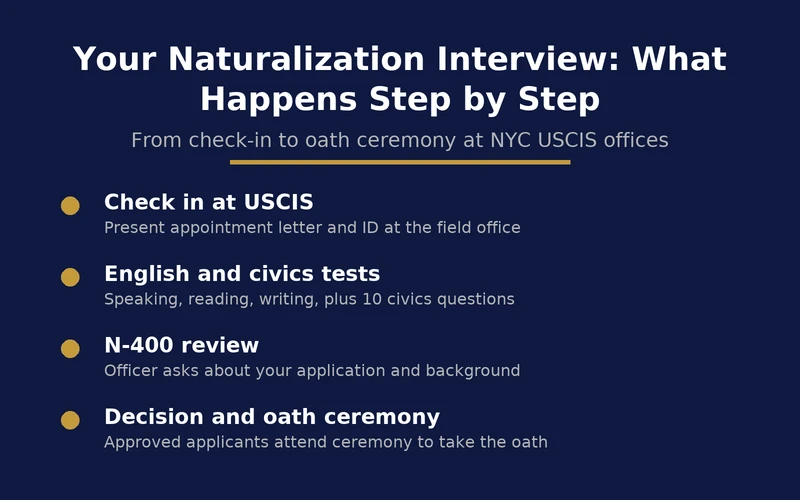
The naturalization interview New York takes place at a USCIS field office, typically at 26 Federal Plaza in lower Manhattan or the Garden City office on Long Island. The interview lasts 20 to 40 minutes and covers three main areas: your application background, the English test, and the civics test.
I remember how nervous my mother was before her citizenship interview. She studied for weeks and still felt unprepared. At Zavala Immigration Law Firm, we help New York immigrants prepare so they can walk in knowing exactly what to expect during their naturalization interview New York.
The Check-In Process
Arrive at least 30 minutes before your scheduled appointment. Bring your appointment letter, green card, government photo ID, and all original documents referenced in your N-400 application. At check-in, a USCIS staff member will verify your identity and direct you to the waiting area.
The Three Parts of the Interview
The interview has three components. First, the officer reviews your N-400 application and asks questions about your background, travel history, and moral character. Second, you take the English test, which includes speaking, reading, and writing. Third, you take the civics test, which covers U.S. history and government.
- Application review: officer asks about your N-400 answers
- English test: speaking, reading a sentence, writing a sentence
- Civics test: 10 questions from the official 100-question list
- Decision: officer tells you the results or says a decision will be mailed
Practical rule: Answer every question truthfully. If you do not know an answer, say so. Guessing or lying during your naturalization interview can result in denial and referral to immigration court.
The English Test: What You Need to Know
The English test has three parts: speaking, reading, and writing. The officer evaluates your ability to speak English during the interview conversation. For reading, you must read one sentence aloud from a provided list. For writing, you must write one sentence that the officer dictates.
Speaking Test
Your speaking ability is evaluated throughout the interview based on your answers to the officer’s questions. The officer assesses whether you can understand questions and respond in English. If you struggle with English, consider taking English classes before your interview.
Reading and Writing Test
USCIS provides a vocabulary list for the reading and writing tests. The officer asks you to read one sentence aloud and write one sentence. If you fail the first attempt, you get two more tries. The USCIS study materials page has the complete vocabulary lists.
Exemptions From the English Test
Some applicants are exempt from the English requirement based on age and time as a permanent resident. If you are 50 or older and have been a permanent resident for 20 years, or 55 or older with 15 years as a permanent resident, you can take the civics test in your native language. If you are 65 or older with 20 years as a permanent resident, you take a simplified version of the civics test.
Practical rule: English test exemptions are based on age and years as a green card holder. Check your eligibility before assuming you must take the English test.
The Civics Test: 100 Questions Explained
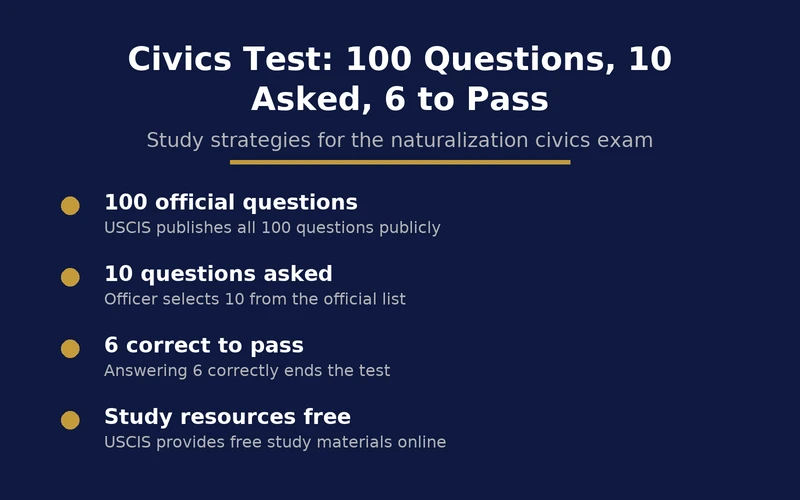
The civics test is the part of the naturalization interview New York that many applicants fear the most. USCIS publishes all 100 questions publicly. The officer asks 10 questions, and you must answer 6 correctly to pass. If you answer 6 correctly, the test ends immediately.
How to Study Effectively
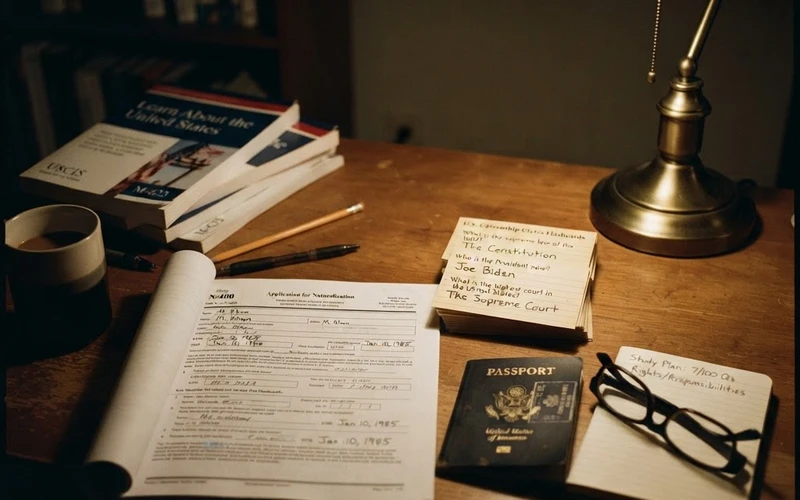
USCIS provides free study materials including flashcards, practice tests, and a study booklet. Start studying at least 3 months before your interview. Focus on the questions most likely to be asked first, such as the name of the current president, your state’s senator, and the capital of the United States. Our citizenship attorney services include interview preparation guidance.
What If You Fail the Civics Test
If you fail the civics test or the English test, you get a second opportunity. USCIS schedules a retest within 60 to 90 days of your first interview. You only retake the portion you failed. If you fail the second attempt, your naturalization application is denied, but you can reapply.
Documents to Bring to Your Interview
Bringing the right documents to your naturalization interview New York shows USCIS you are prepared and organized. Missing documents can delay your case or cause the officer to reschedule.
| Document | Why You Need It |
|---|---|
| Interview appointment letter | Proof of your scheduled appointment |
| Permanent resident card (green card) | Proof of your current lawful status |
| Government photo ID | Driver license, passport, or state ID |
| Original N-400 and supporting documents | All documents referenced in your application |
| Tax returns (last 3 years) | Evidence of tax compliance and good moral character |
| Proof of selective service registration | Required for male applicants under 31 |
| Marriage certificate (if applicable) | If applying through marriage to U.S. citizen |
If Your Situation Has Changed Since Filing
If your address, marital status, or criminal record has changed since you filed your N-400 application, bring documentation of the changes. Tell the officer about any changes at the beginning of the interview. Failing to disclose changes can result in denial for lack of good moral character.
Practical rule: If anything has changed since you filed your N-400, bring proof and tell the officer. Honesty about changes protects your credibility.
Common Reasons Naturalization Applications Are Denied
Understanding why applications are denied helps you avoid mistakes during your naturalization interview New York the same mistakes during your naturalization interview New York.
Failure to Establish Good Moral Character
USCIS evaluates whether you have demonstrated good moral character during the statutory period, typically 5 years before filing. Criminal convictions, tax issues, or failure to pay child support can result in a finding that you lack good moral character. Our naturalization attorney services help clients address character concerns before filing.
Long Trips Outside the United States
Trips of 6 months or more can break your continuous residence. If you traveled for 6 to 12 months, USCIS may presume you abandoned your residence, and you must prove otherwise. Trips over 1 year generally break continuous residence unless you took steps to preserve it.
Failure to Register for Selective Service
Male applicants between 18 and 26 must have registered for Selective Service. Failure to register can result in denial. If you did not register, you must provide evidence that you did not knowingly fail to register.
Practical rule: If you have any criminal history, tax debt, or long absences from the U.S., consult an attorney before filing your N-400 to address potential issues.
Preparing for the N-400 Review Portion
During the application review portion of your naturalization interview New York, the officer goes through your N-400 application question by question. Understanding what they focus on helps you prepare.
Questions About Your Travel History
The officer will review all trips outside the United States since you became a permanent resident. They check whether any trip broke your continuous residence. Bring a list of all travel dates, even short trips to Canada or Mexico. The USCIS citizenship resources page provides guidance on travel documentation.
Questions About Your Marital Status
If you applied based on marriage to a U.S. citizen, the officer may ask about your marriage. They want to confirm the marriage is genuine and ongoing. If your situation has changed, such as a separation or divorce, you must inform the officer immediately.
Questions About Criminal History
The officer will ask about all arrests, charges, and convictions listed on your N-400 application. You must bring certified court dispositions for every arrest, even if the case was dismissed. Failing to disclose an arrest can result in denial for lack of candor, even if the arrest would not have affected your eligibility. Our USCIS attorney services help clients prepare complete criminal record disclosures.
Practical rule: Bring certified court dispositions for every arrest on your record. Failing to disclose an arrest is worse than the arrest itself in the eyes of USCIS.
Accommodations for Disabilities
If you have a disability that affects your ability to take the English or civics test, you can request accommodations from USCIS.
Medical Disability Exceptions
Applicants with physical or developmental disabilities or mental impairments can request a medical exception from the English and civics requirements. A licensed medical professional must complete Form N-648 certifying the disability. The USCIS accommodations page explains the process. Each accommodation request is evaluated individually.
What If You Need an Interpreter
If you qualify for the age and time exemption from the English requirement, you may bring an interpreter to translate the civics test questions and your answers. The interpreter must be fluent in both English and your native language. USCIS does not provide interpreters for the naturalization interview.
Special Situations That Affect Your Interview
Certain life situations can change how your naturalization interview New York proceeds. Being prepared for these scenarios reduces stress and improves your chances.
If You Applied Through Marriage to a U.S. Citizen
The 3-year statutory period for spouses of U.S. citizens means you can apply for naturalization sooner. However, the officer will verify that you are still married to and living with your U.S. citizen spouse. Bring your marriage certificate, joint tax returns, and evidence of shared residence. If you are separated but not divorced, you may not qualify for the 3-year rule and may need to wait for the 5-year rule.
If You Have Traveled Extensively Since Filing
If you have taken trips outside the United States since filing your N-400 application, bring an updated list of all travel dates and destinations. The officer needs to verify that your trips did not break your continuous residence. If any single trip lasted more than 6 months, be prepared to explain and provide evidence that you maintained your U.S. residence during the trip. The State Department visa information page provides travel-related guidance.
If Your Name Changed Since Filing
If you legally changed your name since filing your N-400, bring the court order or marriage certificate documenting the change. USCIS can update your name on your Certificate of Naturalization if you request it at the interview. If you want to change your name as part of the naturalization process, you can request it at the interview, and the new name will appear on your certificate.
Practical rule: If anything about your life has changed since you filed your N-400, bring documentation. The officer will ask about changes, and being prepared shows respect for the process.
The Oath Ceremony: Becoming a U.S. Citizen
If you pass your naturalization interview New York, the final step after your naturalization interview New York is the oath ceremony. This is where you take the Oath of Allegiance and receive your Certificate of Naturalization.
What Happens at the Oath Ceremony
The ceremony is a formal event where you and other new citizens take the oath together. You will receive your Certificate of Naturalization, which serves as proof of U.S. citizenship. You can then apply for a U.S. passport and update your Social Security records.
If You Cannot Attend the Scheduled Ceremony
If you cannot attend the scheduled ceremony, you must return the notice to USCIS and request a new date. Failing to appear without notifying USCIS can result in denial of your naturalization.
After the Interview: What Comes Next
After your naturalization interview New York, the officer will either tell you the decision or inform you that a decision will be mailed. Understanding the timeline helps you know what to expect.
If the Officer Cannot Make a Decision That Day
Sometimes the officer needs additional time to review your case, wait for background check results, or consult a supervisor. This is normal and does not necessarily mean your case is in trouble. You should receive a decision within 120 days of your interview. If you do not, you can request a status update or file a lawsuit to compel a decision.
If Your Application Is Approved
If approved, you will receive a notice scheduling your oath ceremony. The ceremony is typically held 1 to 2 months after the interview. You will take the Oath of Allegiance, receive your Certificate of Naturalization, and officially become a U.S. citizen. From that moment, you can register to vote, apply for a U.S. passport, petition for family members, and enjoy all the rights and responsibilities of U.S. citizenship that you have worked so hard to earn over many years of hard work.
Frequently Asked Questions About Naturalization Interviews in New York
| Question | Answer |
|---|---|
| How long does the naturalization interview New York take? | The interview typically lasts 20 to 40 minutes, but plan to be at the USCIS office for 1 to 2 hours including wait time. |
| What happens if I fail the English or civics test? | You get a second chance within 60 to 90 days. You only retake the portion you failed. |
| Can I bring an attorney to my naturalization interview? | Yes. You have the right to bring an attorney, and having one can help if complications arise. |
| What should I wear to the interview? | Dress professionally as outlined by USCIS citizenship guidance, as a sign of respect. Business casual is appropriate. |
| Do I need to memorize all 100 civics questions? | No, but you should know the answers well. The officer asks 10 and you must answer 6 correctly. |
| Can I take the civics test in Spanish? | Only if you qualify for the age and time exemption, or if you have a medical disability accommodation. |
| How long after the interview do I become a citizen? | If approved, you become a citizen at the oath ceremony, which is typically scheduled 1 to 2 months after the interview. |
Preparing for Your Citizenship Interview in New York
Your naturalization interview New York is a milestone in your journey to U.S. citizenship. With proper preparation and study, you can walk in confident and ready. Call our team at (718) 717-7989 or visit our contact page to schedule a consultation. Zavala Immigration Law Firm helps New York immigrants prepare for every step of the naturalization process.
About Eliud Zavala, Eliud Zavala is the founder of Zavala Immigration Law Firm. Having immigrated to the United States with his mother from Monterrey, Mexico, Eliud understands the emotional and legal struggles immigrant families experience. He serves the New York immigrant community, guiding individuals and families through family-based immigration, marriage green cards, provisional waivers, deportation defense, and citizenship.