

When ICE comes to your home New York, you have constitutional rights that protect you and your family regardless of your immigration status. The Fourth Amendment applies to everyone in the United States, including undocumented immigrants, and it means ICE cannot enter your home without a judicial warrant signed by a judge. Knowing what to do when ICE comes to your home New York ICE comes to your home New York can mean the difference between staying with your family and being placed in removal proceedings.
Know Your Rights Before ICE Arrives
Here is the reality: ICE enforcement in New York happens, and it often happens without warning. Agents may show up at your door early in the morning or late at night. If you are not prepared, fear and confusion can lead to mistakes that compromise your rights. Preparation for when ICE comes to your home New York is your strongest defense.
I have seen what happens when families are not ready. People open the door, answer questions they do not have to answer, and sign documents they do not understand. At Zavala Immigration Law Firm, we fight for immigrant families in New York every day. Knowing your rights before ICE comes to your home New York is the first step in protecting your family.
The Fourth Amendment Protects Everyone
The Fourth Amendment of the U.S. Constitution protects against unreasonable searches and seizures. This means ICE agents cannot enter your home without a warrant signed by a judge, not just an ICE supervisor. The ACLU Know Your Rights guide provides detailed information about your constitutional protections during ICE encounters.
What to Teach Your Family Members
Every person in your household should know what to do if ICE comes to the door. Children, elderly family members, and roommates all need to understand the basics. Create a family plan that includes who to call, where important documents are kept, and what to say.
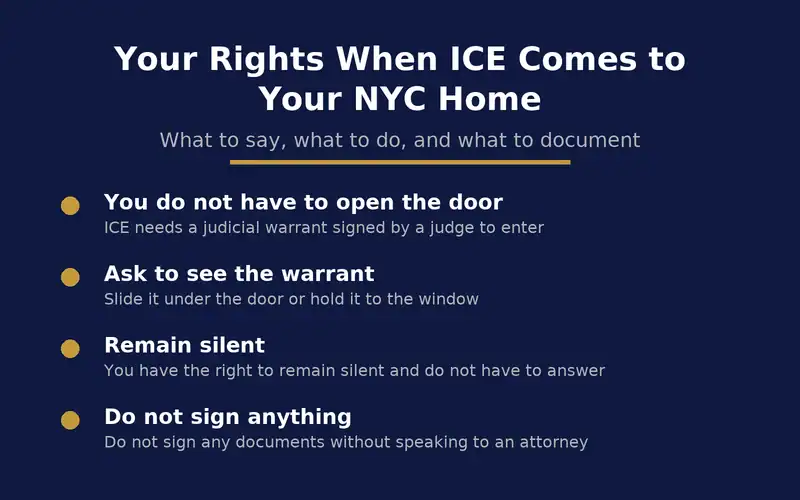
- Do not open the door unless ICE has a judicial warrant
- Ask agents to slide the warrant under the door or hold it to a window
- Everyone has the right to remain silent
- Do not sign anything without speaking to an attorney
- Keep your immigration attorney’s phone number saved in every family member’s phone
Practical rule: ICE agents often carry administrative warrants, not judicial warrants. An administrative warrant does not authorize them to enter your home. Only a warrant signed by a judge gives them that authority.
The Difference Between Judicial and Administrative Warrants
Understanding the difference between warrant types when ICE comes to your home New York is the single most important thing to know when ICE comes to your home New York. This distinction determines whether ICE has the legal authority to enter your residence.

What a Judicial Warrant Looks Like
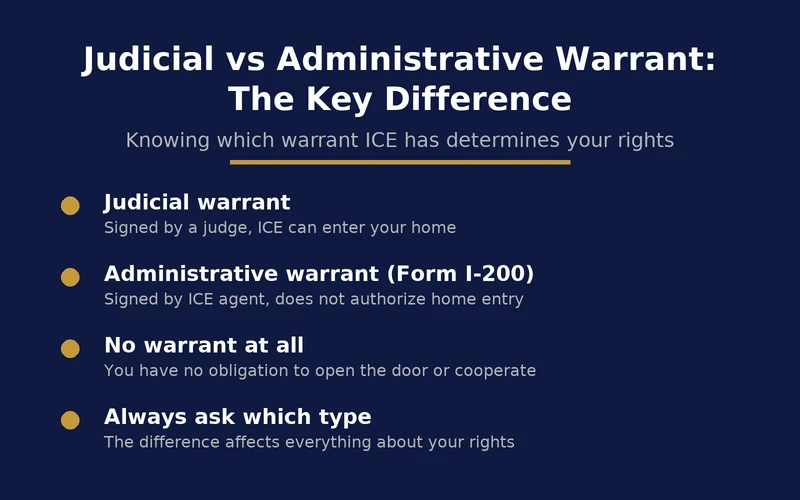
A judicial warrant is signed by a federal judge or magistrate and has the seal of a U.S. District Court. It specifically names the person to be arrested or the location to be searched. If ICE presents a judicial warrant, you must comply because it has legal authority for entry.
What an Administrative Warrant Looks Like
An administrative warrant, often Form I-200, is signed by an ICE agent, not a judge. It does not give ICE the authority to enter your home. You are not required to open the door for an administrative warrant. The ICE official website provides information about agency procedures, but it does not override your constitutional rights.
| Type of Warrant | Signed By | Can ICE Enter Your Home? | What You Should Do |
|---|---|---|---|
| Judicial warrant | Federal judge or magistrate | Yes, they can enter | Comply but remain silent and call your attorney |
| Administrative warrant (I-200) | ICE agent or supervisor | No, they cannot enter without consent | Do not open the door, ask them to slide it under |
| No warrant at all | Nobody | No, absolutely not | Do not open the door, do not answer questions |
| ICE warrant of arrest | ICE agent | No, not for home entry | Treat same as administrative warrant |
Practical rule: Always ask to see the warrant before opening the door. Look for a judge’s signature and a court seal. If you do not see both, do not open the door.
What to Do During an ICE Encounter
If ICE comes to your home New York, follow these steps to protect your rights when ICE comes to your home New York and your family.
Step 1: Do Not Open the Door
You are not required to open your door for ICE agents. Speak through the door or a window. Ask if they have a warrant. If they say yes, ask them to slide it under the door or hold it up to a window where you can read it.
Step 2: Examine the Warrant Carefully
Look at who signed it. If it was signed by a judge and has a court seal, it is a judicial warrant and you must comply. If it was signed by an ICE agent, it is an administrative warrant and you do not have to open the door.
Step 3: Exercise Your Right to Remain Silent
You have the right to remain silent. You do not have to answer questions about your immigration status, where you were born, or how you entered the country. You do not have to show any documents unless ICE has a judicial warrant.
Step 4: Do Not Sign Anything
ICE may ask you to sign documents, including a voluntary departure form or a stipulated removal order. Do not sign anything without speaking to an attorney first. Signing these documents can waive your rights to a hearing and result in immediate deportation.
Practical rule: Signing a voluntary departure or stipulated removal without an attorney is one of the fastest ways to get deported. Never sign ICE documents without legal advice.
New York Sanctuary City Policies and Their Limits
New York City has sanctuary policies that limit cooperation between local law enforcement and federal immigration authorities. However, these policies do not prevent ICE from conducting enforcement actions in New York. ICE can still arrest people at their homes, workplaces, and courthouses.
What Sanctuary Policies Actually Protect
NYC sanctuary policies generally prohibit city employees, including police, from asking about immigration status or cooperating with ICE detainers except in specific circumstances involving serious criminal convictions. These policies do not apply to federal ICE agents operating independently.
Where ICE Can Still Operate in New York
Despite sanctuary policies, ICE conducts home raids, workplace enforcement, and courthouse arrests in New York. The Executive Office for Immigration Review oversees immigration courts, and ICE operates as a federal agency not bound by city policies. Our deportation defense team handles cases arising from all types of ICE encounters.
Practical rule: Sanctuary city policies do not make you immune from ICE enforcement. They limit local police cooperation, not federal immigration enforcement.
What to Do After an ICE Encounter
If ICE comes to your home New York and arrests a family member, there are immediate steps you should take to protect their case.
Contact an Immigration Attorney Immediately
Time is of the essence after an arrest. An attorney can locate the detained family member, determine the charges, and begin building a defense. Contact our New York immigration attorneys as soon as possible.
Locate the Detained Family Member
Use the ICE Online Detainee Locator System to find where your family member is being held. You will need their full name and country of birth, or their A-number. The system searches ICE detention facilities nationwide.
Request an Immigration Bond Hearing
If your family member is detained, an attorney can request a bond hearing before an immigration judge. The judge will set a bond amount based on flight risk and public safety. Our New York immigration lawyer team handles bond hearings regularly.
Gather Supporting Documents
Start gathering documents that support your family member’s case: proof of family ties in the U.S., employment records, tax returns, medical records, and character references. These documents will be needed for bond hearings and relief applications.
Creating a Family Safety Plan
Every immigrant family in New York should have a safety plan in case ICE comes to your home New York ICE comes to your home New York. Planning ahead reduces panic and protects your family’s rights.
Documents to Keep in a Safe Place
Keep copies of all immigration documents, passports, birth certificates, marriage certificates, and medical records in a secure location. Tell a trusted family member or friend where these documents are kept. Having organized records makes it easier to act quickly if someone is detained.
Power of Attorney and Child Care Plans
If you have children, designate a trusted person who can care for them if you are detained. Consider creating a power of attorney that authorizes someone to make decisions for your children and manage your finances. Talk to a family law attorney about the right documents for your situation.
Practical rule: A family safety plan is not paranoia. It is responsible preparation that every immigrant family in New York should have.
ICE Enforcement Trends in New York City
Understanding how ICE operates in New York helps families prepare for the possibility that ICE comes to your home New York. Enforcement patterns shift based on federal policy directives, but certain patterns remain consistent.
When ICE Is Most Likely to Visit
ICE home raids often occur early in the morning, between 4 AM and 7 AM, when agents expect people to be home. They may also conduct enforcement actions at workplaces, courthouses, and on the street. Knowing these patterns helps families prepare. The Immigration Research Initiative provides data on enforcement trends in New York.
ICE Operations at NYC Courthouses
Despite New York’s efforts to limit courthouse arrests, ICE agents have conducted enforcement actions at state courthouses. This creates fear among immigrants who need to appear in court for unrelated matters. If you must go to court, consult with an attorney about your risk and whether courthouse ICE encounters are a concern for your case.
Workplace Enforcement Actions
ICE can conduct workplace audits using Form I-9 inspections, which require employers to verify employee work authorization. These audits can lead to employee termination and ICE enforcement. If your employer receives an I-9 audit notice, you should consult an immigration attorney immediately. Our employment immigration services help both workers and employers understand their obligations.
Practical rule: ICE enforcement patterns vary by policy, but early morning home visits and courthouse enforcement remain common in New York. Prepare accordingly.
Legal Options After Detention
If a family member is detained after ICE comes to your home New York, several legal options may be available depending on their immigration history.
Seeking Asylum or Withholding of Removal
If your family member fears persecution in their home country, they may be eligible for asylum or withholding of removal. These protections require demonstrating a well-founded fear of persecution based on race, religion, nationality, political opinion, or membership in a particular social group. The ACLU immigrants’ rights page provides educational resources.
Cancellation of Removal for Long-Term Residents
Individuals who have lived in the United States for 10 years or more, have good moral character, and can show exceptional and extremely unusual hardship to a U.S. citizen or permanent resident family member may qualify for cancellation of removal. This is a powerful form of relief but difficult to prove.
Voluntary Departure as a Last Resort
If no other relief is available, voluntary departure allows the person to leave the United States at their own expense within a specified timeframe. This avoids the penalties of a formal removal order, which can include a 10-year bar to reentry. However, voluntary departure should only be considered after consulting with an attorney about all other options. Our family immigration team evaluates every possible form of relief.
What to Do If ICE Follows You From Work
If ICE agents follow you from your workplace to your home, do not lead them to other family members. Drive to a public place and call your attorney. ICE agents sometimes use workplace visits to identify home addresses for later enforcement. Being aware of this tactic helps you protect your household.
Recording ICE Encounters Legally
In New York, you can legally record conversations with ICE agents if you are a party to the conversation. Recording the encounter creates a record of what was said and whether agents respected your rights. However, do not interfere with agents or obstruct their duties. Simply record quietly if you choose to do so.
Resources for New York Immigrant Families
New York has several organizations that provide resources and support for immigrant families facing ICE encounters. The NYC Mayor’s Office of Immigrant Affairs offers information and referrals. Community organizations throughout the five boroughs provide free Know Your Rights training sessions that teach families what to do during enforcement encounters. These trainings are valuable for every family member, including children old enough to understand.
Frequently Asked Questions About ICE Home Visits in New York
| Question | Answer |
|---|---|
| Do I have to open the door when ICE comes to your home New York? | No. You are not required to open the door unless ICE has a judicial warrant signed by a judge. |
| What is the difference between a judicial and administrative warrant? | A judicial warrant is signed by a judge and allows entry. An administrative warrant is signed by an ICE agent and does not authorize home entry. |
| Do I have to answer ICE questions? | No. You have the right to remain silent. You do not have to answer questions about your immigration status or country of origin. |
| Can ICE enter my home without a warrant? | No. The Fourth Amendment protects against warrantless entry. ICE needs either a judicial warrant or your consent to enter. |
| What should I do if ICE arrests a family member? | Contact an immigration attorney immediately, use the ICE detainee locator, and gather supporting documents for a bond hearing. |
| Do NYC sanctuary policies protect me from ICE? | Sanctuary policies limit local police cooperation with ICE but do not prevent federal ICE agents from conducting enforcement actions. |
| Should I sign voluntary departure if ICE offers it? | Never sign any ICE document without speaking to an attorney first. Voluntary departure waives your right to a hearing. |
Protecting Your Family When ICE Comes to Your Door
When ICE comes to your home New York, preparation and knowledge for when ICE comes to your home New York are your strongest defenses. Call our team at (718) 717-7989 or visit our contact page to create a family safety plan. Zavala Immigration Law Firm fights for New York immigrant families every day.
About Desiree Borges-Tosado, Desiree Borges-Tosado is an attorney at Zavala Immigration Law Firm in New York. With Puerto Rican roots and a JD from Pontifical Catholic University, she brings a background in public policy and immigration courts to every case. She handles deportation defense, asylum claims, immigration bonds, and BIA appeals with a fierce, direct approach that tells clients the truth upfront and fights aggressively for their rights.