

Adjustment of status New York is the process that allows certain immigrants to apply for a green card without leaving the United States, avoiding the risks and delays of consular processing abroad. If you entered with a valid visa, married a U.S. citizen, or qualify under a special provision, you may be able to complete your entire adjustment of status New York case at a local USCIS field office without ever departing. Understanding whether you qualify for adjustment of status New York depends on how you entered, your current immigration status, and your family relationships.
What Adjustment of Status Actually Means
Adjustment of status is the legal process of changing from a nonimmigrant or undocumented status to lawful permanent resident status while remaining inside the United States. The adjustment of status New York application is filed on Form I-485 with USCIS, and if approved, you receive your green card by mail without needing to travel to an embassy abroad. This process is available only to certain immigrants who meet specific eligibility requirements.
I went through my own immigration journey with my mother, and I know how much it means to be able to stay in the country while your case is processed. At Zavala Immigration Law Firm, we help New York families understand whether adjustment of status New York is an option or whether they need an alternative path.
The Difference Between Adjustment and Consular Processing
The main alternative to adjustment is consular processing, which requires you to travel to a U.S. embassy in your home country for an immigrant visa interview. Adjustment happens entirely inside the United States through USCIS. Consular processing happens abroad through the State Department. The key factor determining which path you take is how you entered the country.
Who Can File Form I-485 in New York
You can file the I-485 application if you have an approved or pending I-130 petition from a qualifying family member and you meet the eligibility requirements. Immediate relatives of U.S. citizens have the most straightforward path. The USCIS adjustment of status page provides the official requirements.
- Immediate relatives of U.S. citizens (spouses, parents, unmarried children under 21)
- Family preference immigrants with current priority dates
- Diversity visa lottery winners present in the U.S.
- Refugees and asylees after one year of status
- Special immigrants including religious workers and NATO employees
Practical rule: If you entered with a valid visa and are marrying a U.S. citizen, you can almost certainly adjust status. If you entered without inspection, you need a different strategy.
Who Qualifies for Adjustment of Status in New York
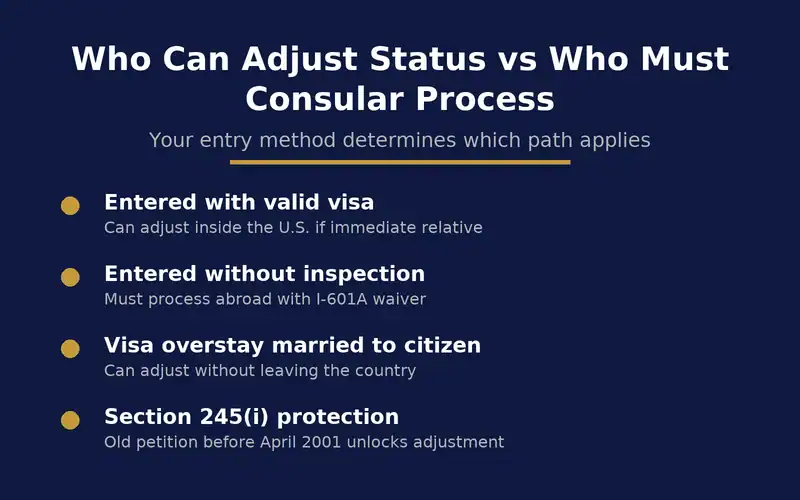
Eligibility for adjustment of status New York depends on several factors. The most important is whether you were inspected and admitted or paroled into the United States when you entered.
Visa Overstays Married to U.S. Citizens
If you entered the United States with a valid visa and later married a U.S. citizen, you can adjustment of status even if your visa has expired. As an immediate relative of a U.S. citizen, your overstay does not prevent you from adjusting. This is one of the most common pathways we see in our New York office.
Section 245(i) Protection for Entry Without Inspection
If you entered without inspection, you generally cannot adjust status inside the United States. However, Section 245(i) of the INA provides an exception if a family member or employer filed a visa petition for you on or before April 30, 2001. If you qualify under 245(i), you can adjust by paying a penalty fee. Many people do not know that an old petition from decades ago could unlock this protection. The full text of INA Section 245 on law.cornell.edu explains the legal framework.
Asylees and Refugees
Refugees can apply for adjustment after one year of being admitted. Asylees can apply one year after asylum is granted. Both groups file Form I-485 but are exempt from many of the requirements that apply to other applicants. Our team helps asylees in New York transition to permanent residency through family immigration pathways.
Practical rule: Always check for Section 245(i) eligibility before assuming you must leave the country. An old petition could save you years of separation.
The I-485 Process at New York USCIS Field Offices
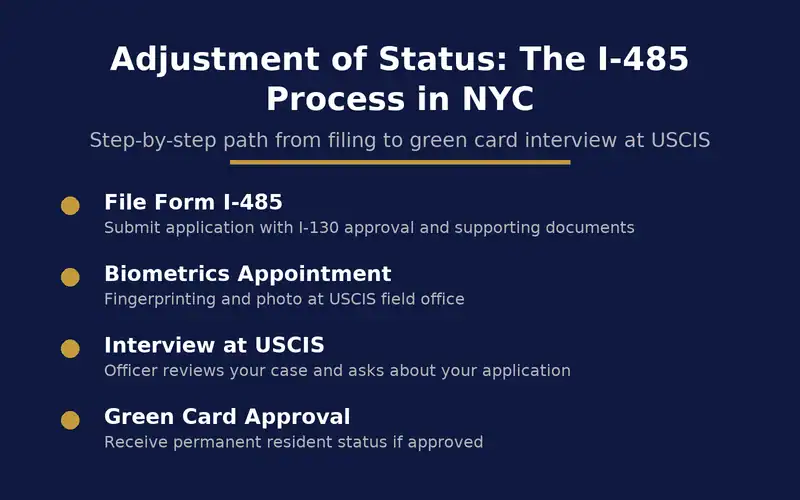
The adjustment of status New York process involves several stages at USCIS. New York has multiple field offices that handle these cases, including the main office at 26 Federal Plaza in lower Manhattan.

Filing the I-485 Package
The I-485 package includes the application form, the I-130 petition if not already approved, supporting documents, biometric fee, and medical examination results on Form I-693. Filing fees vary depending on the applicant’s age and category. Our USCIS attorney services help New York families prepare complete packages.
Biometrics and Background Check
After filing, USCIS schedules a biometrics appointment where you provide fingerprints, photo, and signature. These are used for background checks through FBI databases. The appointment typically occurs 4 to 8 weeks after filing.
The Adjustment Interview
Most applicants must attend an in-person interview at a USCIS field office. The officer reviews your application, asks about your relationship and background, and verifies your supporting documents. For marriage green card cases, the officer asks questions to confirm the marriage is genuine. Our New York immigration lawyer team prepares clients for every question.
Common Barriers to Adjustment of Status
Several issues can prevent or delay adjustment of status New York cases. Knowing these in advance helps you prepare a stronger application.
Criminal Convictions and Inadmissibility
Certain criminal convictions can make you inadmissible and disqualify you from adjustment. Not all convictions have the same impact. A crime involving moral turpitude or a controlled substance offense can trigger inadmissibility. If you have any criminal history, you need an attorney to evaluate whether a waiver is available. Our deportation defense team handles these evaluations.
Public Charge Considerations
USCIS evaluates whether an applicant is likely to become a public charge. The sponsor must file Form I-864 Affidavit of Support showing sufficient income to support the immigrant. Income must be at least 125% of the federal poverty guidelines. Assets can supplement income if the sponsor does not meet the threshold.
Prior Immigration Violations
Prior deportations, visa fraud, or misrepresentation can create inadmissibility grounds. Some of these have waivers available, while others create permanent bars. Each situation requires individualized legal analysis by an experienced immigration attorney.
Practical rule: Disclose everything to your attorney. Hiding a prior issue is worse than dealing with it upfront with a plan.
Processing Times in New York
Processing times for adjustment of status New York vary depending on the USCIS field office handling your case. New York offices typically process I-485 applications in 10 to 24 months. You can check current processing times on the USCIS processing time tool.
| Step | What Happens | Typical Timeline |
|---|---|---|
| 1. File I-130 and I-485 | Submit petition and adjustment application together | Week 1 |
| 2. Biometrics Appointment | Fingerprinting and photo at USCIS | 4 to 8 weeks |
| 3. Interview Notice | USCIS schedules your in-person interview | 8 to 18 months |
| 4. Interview | Officer reviews your case at the field office | 10 to 20 months |
| 5. Decision | USCIS approves or denies your application | 2 to 4 weeks after interview |
| 6. Green Card Arrives | Card mailed to your New York address | 4 to 8 weeks after approval |
Work Authorization and Travel While Your Case Is Pending
While your adjustment of status New York case is pending, you can apply for a work permit (Form I-765) and advance parole (Form I-131) at no additional cost when filed with the I-485. The work permit allows you to work legally, and advance parole allows you to travel abroad and return without abandoning your case.
When You Can Start Working
The EAD typically arrives 4 to 8 months after filing. Once you have your work permit, you can work for any employer in the United States. Many New York applicants use this period to start new jobs or change careers while waiting for their green card.
Travel Risks During Pending Adjustment
Traveling without advance parole while your adjustment is pending will abandon your application. If you have advance parole, traveling is generally safe, but each trip should be discussed with your attorney first. The USCIS travel guidance provides official information.
Practical rule: Never travel outside the U.S. without advance parole while your adjustment case is pending. Doing so will terminate your application.
Adjustment of Status and the Conditional Green Card
If your marriage green card was based on a marriage that was less than two years old at the time of approval, you receive a conditional green card valid for two years. You must file Form I-751 to remove conditions during the 90-day window before the card expires.
Removing Conditions on Your Green Card
Filing the I-751 requires evidence that your marriage was entered in good faith. Joint financial records, lease agreements, photos, and affidavits from friends support this petition. If you divorce before removing conditions, you can request a waiver but must prove the marriage was genuine despite the divorce.
What Happens If Your Adjustment Is Denied
If USCIS denies your adjustment of status New York application, you can appeal the decision or file a motion to reopen. In some cases, you may be referred to immigration court. Having an experienced attorney at every stage gives you the best chance of approval and the strongest position if you need to appeal. Our waiver attorney services help clients overcome denial.
Practical rule: Conditional green card holders must file the I-751 on time. Missing the 90-day window creates serious complications.
Special Adjustment Categories in New York
Beyond the standard family-based adjustment of status New York pathway, several specialized categories allow immigrants to adjust under unique provisions.
Violence Against Women Act Self-Petitioners
Survivors of domestic violence married to U.S. citizens or permanent residents can self-petition under VAWA without the abuser’s knowledge or cooperation. VAWA self-petitioners who are present in the United States can adjust status if they meet the eligibility requirements. This provides a safe and confidential pathway to permanent residency for abuse survivors. The USCIS VAWA page provides official information.
Special Immigrant Juvenile Status
Children who have been abused, neglected, or abandoned by one or both parents may qualify for Special Immigrant Juvenile Status (SIJS). This pathway requires a family court order finding that the child is dependent on the court and that reunification with one or both parents is not viable. SIJS recipients can adjust status inside the United States.
Diversity Visa Winners Present in the U.S.
If you were selected in the diversity visa lottery and are present in the United States, you can adjust status instead of processing through a consulate abroad. This requires filing during the fiscal year of your selection and meeting all eligibility requirements. The State Department diversity visa page provides selection dates and requirements.
Practical rule: Diversity visa winners must file their I-485 during the fiscal year of their selection. Missing this window means losing the opportunity entirely.
What Happens If Your Adjustment Case Is Complicated
Some adjustment of status New York cases involve factors that require factors that require additional legal analysis. Knowing what complications to watch for helps you prepare.
When USCIS Requests Additional Evidence
If USCIS needs more information, they will issue a Request for Evidence (RFE). You typically have 60 to 90 days to respond. Common RFE reasons include missing medical exam results, insufficient financial support evidence, or questions about the bona fides of a marriage. Responding promptly and thoroughly to RFEs keeps your case on track.
Stokes Interview for Marriage Cases
If USCIS suspects a marriage is not genuine, they may schedule a Stokes interview where the couple is separated and questioned individually. The officer compares answers to identify inconsistencies. Having an attorney present during a Stokes interview is essential. Our New York family immigration attorney team prepares clients for this scenario.
What to Do If Your Adjustment Interview Is Scheduled in Spanish
Some USCIS field offices in New York conduct interviews in Spanish if the officer speaks Spanish. However, you should not assume this will happen. If you need an interpreter, you must bring one. The interpreter cannot be your attorney, a family member, or a witness in your case. Plan ahead to ensure you have a qualified interpreter available if you need one.
Updating Your Address While Your Case Is Pending
If you move while your adjustment of status New York case is pending, you must update your address with USCIS within 10 days using Form AR-11. Failing to update your address can result in missing your interview notice, which leads to case denial. You can file the AR-11 online through the USCIS website.
Frequently Asked Questions About Adjustment of Status in New York
| Question | Answer |
|---|---|
| Can I adjustment of status New York if I overstayed my visa? | If you entered with a valid visa and are an immediate relative of a U.S. citizen, you can adjust despite the overstay. |
| Do I need to leave the country for an interview? | No. The adjustment interview takes place at a USCIS field office in New York. You never leave the United States. |
| What if I entered without inspection? | You generally cannot adjust without Section 245(i) protection or another special provision. You may need consular processing with a waiver. |
| How long does the process take in New York? | Typically 10 to 24 months from filing to green card, depending on the USCIS field office backlog. |
| Can I work while my case is pending? | Yes. You can file for a work permit (EAD) with your I-485 at no additional cost. It usually arrives in 4 to 8 months. |
| What happens if my adjustment is denied? | You can appeal, file a motion to reopen, or in some cases be referred to immigration court. An attorney can help evaluate your options. |
| Does a criminal record prevent adjustment? | It depends on the offense. Some convictions trigger inadmissibility that may require a waiver. Always consult an attorney if you have any criminal history. |
Building Your Adjustment of Status Case in New York
Preparing a strong adjustment of status New York case starts with understanding starts with understanding your eligibility and gathering the right documents. Call our team at (718) 717-7989 or visit our contact page to schedule a consultation. Zavala Immigration Law Firm helps New York families build a path to permanent residency without leaving the country. Whether your case is straightforward or involves complications, having an experienced immigration attorney by your side makes the process smoother and significantly increases your chances of approval. Every family deserves the security that comes with permanent residency, and we are here to help you achieve it.
About Eliud Zavala, Eliud Zavala is the founder of Zavala Immigration Law Firm. Having immigrated to the United States with his mother from Monterrey, Mexico, Eliud understands the emotional and legal struggles immigrant families experience. He serves the New York immigrant community, guiding individuals and families through family-based immigration, marriage green cards, provisional waivers, deportation defense, and citizenship.